Products and markets together.
Choose a category, trade issue, or keyword.
See the actual stepsProduct and trade topics
Reorganize scattered updates by business topic to explore their impact on products.
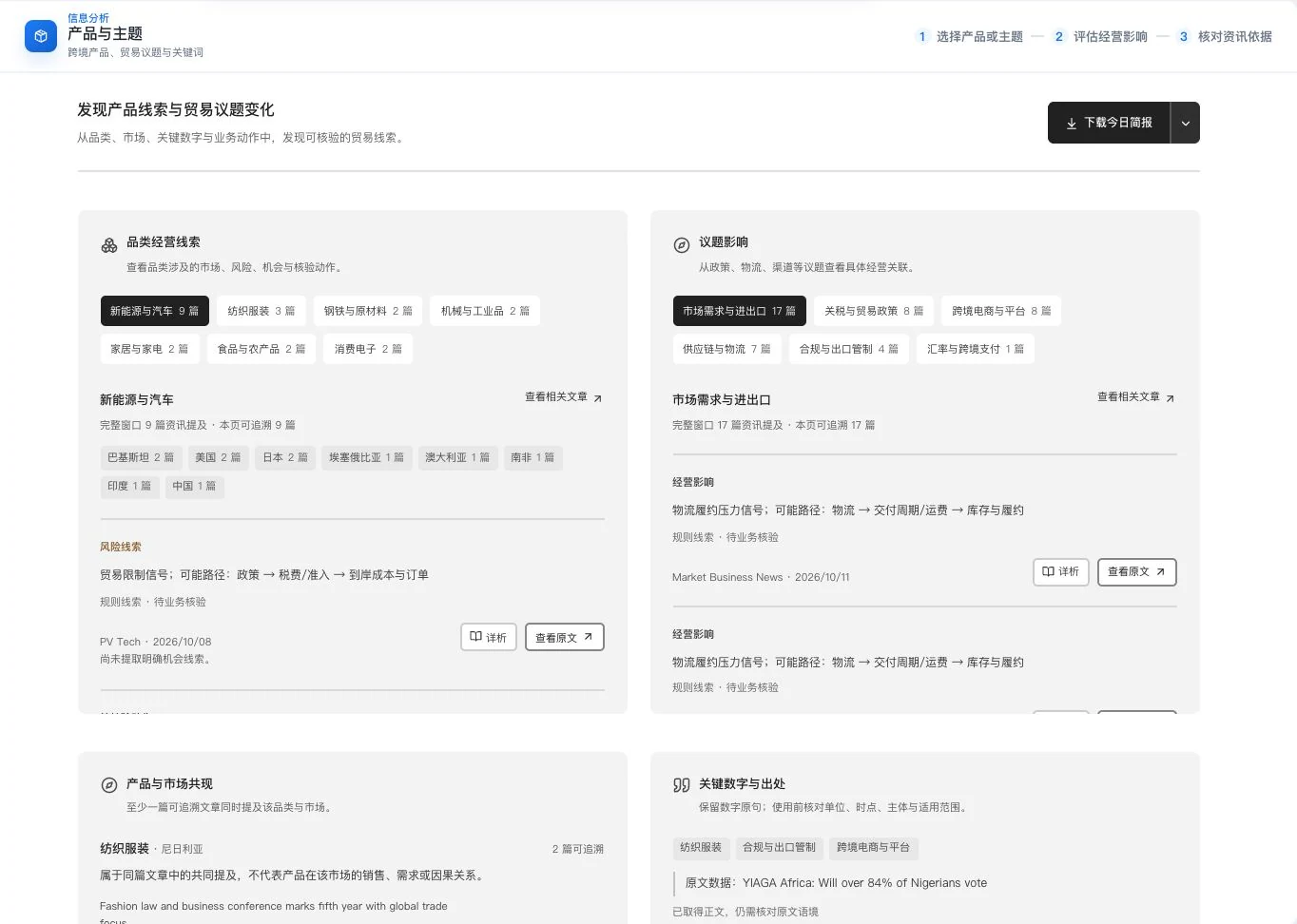
Rule-based leads and original links from the current sample. Complete articles still require checking. Co-occurrence and mentions are not sales, search popularity, or causal proof. No new analysis call occurred.
Reorganize scattered updates by business topic to explore their impact on products.
Source: categories, issues, co-occurrence, figure sources, events, actions, keywords, and evidence gaps. Mention counts are not sales.
See this feature's highlights.
Choose a category, trade issue, or keyword.
See the actual stepsView product-market co-occurrence, figures, events, and actions.
See the actual stepsReturn to original sources and check gaps and applicability.
See how to checkTopic input: a category, trade issue or keyword.
See application scenariosWhen exploring a product, category or trade topic, connect numbers, events and evidence gaps to that topic.
See application scenariosTurn topic research into specific questions or market actions, retaining original sources for later discussion.
See application scenariosUnderstand the tool and human handling separately
Reorganize scattered updates by business topic to explore their impact on products.
View product-market co-occurrence, figures, events, and actions.
This compares feature handling scopes. Scenarios explain the sequence, not measured efficiency or completed customer cases.
Explain the feature through real work
Suppose a product appears in reports about several markets.
Hypothetical scenario · Feature explanation, not a customer case or completed AI resultWhen to use it
When exploring a product, category or trade topic, connect numbers, events and evidence gaps to that topic.
a category, trade issue or keyword.
product-market co-occurrences, number sources and relevant original texts.
Complete steps
8 views cover categories, topics, product-market co-occurrence, numerical sources, events, actions, keywords and evidence gaps. Original links are retained; mention counts are not sales or search popularity.
Choose a category, trade issue, or keyword.
View product-market co-occurrence, figures, events, and actions.
Return to original sources and check gaps and applicability.
Connect the work from step to step
Turn topic research into specific questions or market actions, retaining original sources for later discussion.
Return to Trade information and learning for the complete workflowUnderstand before use
Mention counts are not sales or search popularity. Views use the current information sample.
Product facts and FAQsBack to the product feature directoryMore details in this product
Plan market communication in step with local schedules.
Explore this feature on its own